Devlog #02: Building the Core Systems & Diving Deep into Stats
Hey everyone! Victor here, checking in with a quick update on this month's development progress.
I’ve been focused on building out the fundamental mechanisms for both melee and ranged combat, mainly revolving around the Weapon Card x Skill Card synergy.
1. Weapon-Skill Synergy & Ranged Combat Balance
The core idea is that the same Skill will behave differently based on the Weapon Card used. For example, you might use a thrust skill with both a longsword and a spear. The longsword might deal higher raw damage, while the spear offers a longer reach. The same skill, but different tactical applications.
Ranged Weapons (Bows/Guns): To balance the range advantage of Ranged Weapons, their base damage is lower. This led to the design of the Arrows and Ammo mechanism.
- The Ammo Trade-off: I considered the frustration of not drawing specific cards in a deck-builder (even a 1/3 chance can still mean bad luck for several turns). So, Ammo is designed to be loaded in batches of several shots at once.
- Flexibility: Regular Basic Attacks don't necessarily require pre-loading to offer flexibility. However, Ranged Skills do require pre-loading to ensure these potent shots aren't spammed carelessly.
- Reward Preparation: Ranged attack's advantage truly shines through the High Ground Damage Bonus. In my own testing, it's often the Ranged Skills with the high-ground bonus that deliver devastating output. Overall, I want ranged combat to be a playstyle that requires preparation to maximize its damage potential.
2. New Utility & Multi-Hit Skills
This month, new skills were added to increase utility and functional differentiation:
- I introduced four new movement skills: Knockback**, Pull, Charge, and Retreat**.
- Conditional Advantage: Knockback can Stun a target if they crash into a wall. Pulling a target while you are wearing Heavy Armor can also cause a Stun. These are designed to reward smart use of terrain and character builds. Retreat also ties into a Trap mechanic that is currently being planned.
A particularly unique skill type is Multi-Hit Attacks, such as Double Slash or Triple Shot. These cause multiple low-damage hits within one action. This interacts interestingly with the game’s armor mechanics:
- Armor vs. Multi-Hit: With a fixed damage reduction from armor, a Triple Shot might only do 1, 1, 1 damage against Heavy Armor.
- Defensive Card Interaction (Crucial):
- Block reduces damage from every single hit.
- Dodge only evades the first hit. You will still be hit by the subsequent second and third attacks!
This difference creates a clear distinction between the two defensive cards: Block offers conservative damage mitigation but is still vulnerable to single, powerful hits and bonus effects. Dodge, conversely, is excellent for completely evading single high-damage attacks and their attached effects, but multi-hit attacks pose a dangerous risk.
3. Core Infrastructure: Stats and Deckbuilding Interface
A critical focus this month was infrastructure, namely the Save & Load Game function and the Character Level Up Interface. A game needs progression!
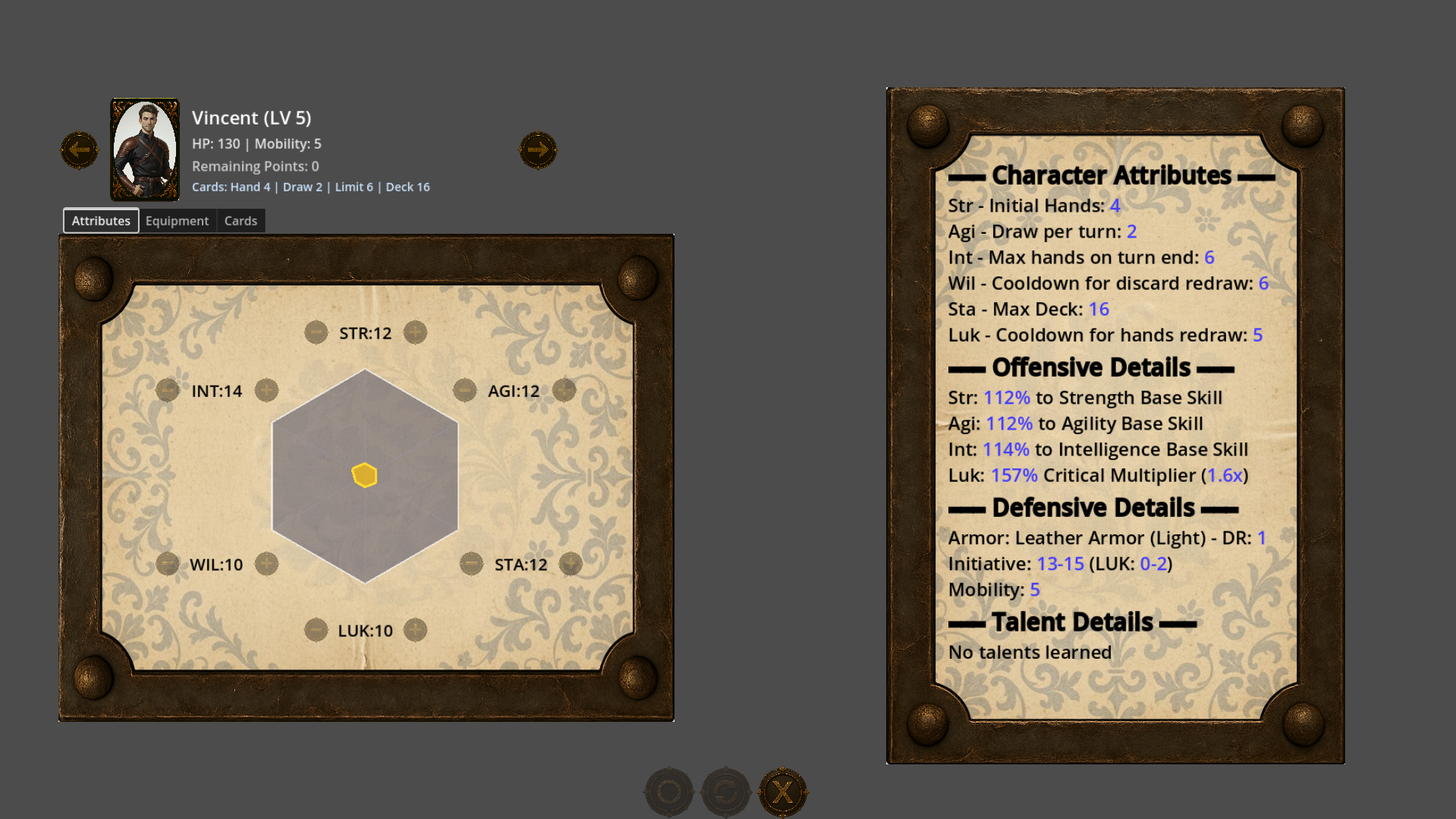
I've laid the groundwork for the basic Character Attributes, Equipment, and Deck Editing screens. The UI is currently very simple and will be refined later to match the overall art style. Character talent pages, more cards, and passive effects are still under development.
Character Attributes and Deck Influence: Crucially, character attributes don't just affect combat numbers like damage and HP; they influence the composition and flow of your deck:
| Attribute | Influence on Deck/Cards |
|---|---|
| Strength | Increases initial hand size, giving high-STR characters immediate high threat. |
| Agility | Affects the number of cards drawn per turn. High-AGI characters can act more often each turn. |
| Intelligence | Increases the number of cards you can retain at the end of a turn, boosting burst potential. |
| Stamina | Increases the maximum deck size, allowing for more versatile decks to handle various situations. |
| Willpower | Speeds up the cooldown recovery for drawing a specific card from the discard pile. High-WIL enables key actions to be recycled quickly in drawn-out fights. |
| Luck | Increases both critical hit damage and the cooldown recovery for the Hand Redraw mechanic (a chance to swap a bad hand for a new one). |
Though the current number of levels and attributes is limited in the prototype, this foundation for how attributes impact your card strategy is now set.
4. Future Focus: Low-Poly Models
I’ve been using cubes and capsules for a few months now, and frankly, I'm tired of looking at them! So, the final month of the year will focus on creating 3D models.
Since I don't have extensive 3D modelling skills (and AI generators haven't delivered the required results), I'm currently self-learning Blender, aiming for a Low-Poly style to reduce the art development time. As a solo developer, I can't dedicate excessive resources to high-fidelity 3D. A pixel art style also proved difficult to achieve, so simple Low-Poly models will be the best approach for presenting the 3D grid-based characters.
I introduced the Web-based demo for you to TRY!!
This Devlog ended up being a bit long, but I hope players who are interested will give the game a try! Whether it’s good or bad, interesting or too complex—I welcome any feedback to ensure I'm moving development in the right direction.
Thank you!
Get Shattera
Shattera
Shattera, a turn-based tactical game where all character actions are driven by a card-based combat system.
| Status | Prototype |
| Author | Victor |
| Genre | Card Game |
| Tags | 3D, Singleplayer, tactical-game, Tactical RPG |
| Languages | English, Chinese, Chinese (Simplified), Chinese (Traditional) |
More posts
- 開發日誌 #02:核心機制的建構8 hours ago
- 開發日誌 #01:原型階段的開發初衷30 days ago
- Devlog #01: The Prototype Stage & Our Design Origin30 days ago
Leave a comment
Log in with itch.io to leave a comment.